
Posted by Angela Lee on 6th Oct 2025
Tri-Screen Laptop Setup: The Complete Guide to Working on Three Screens
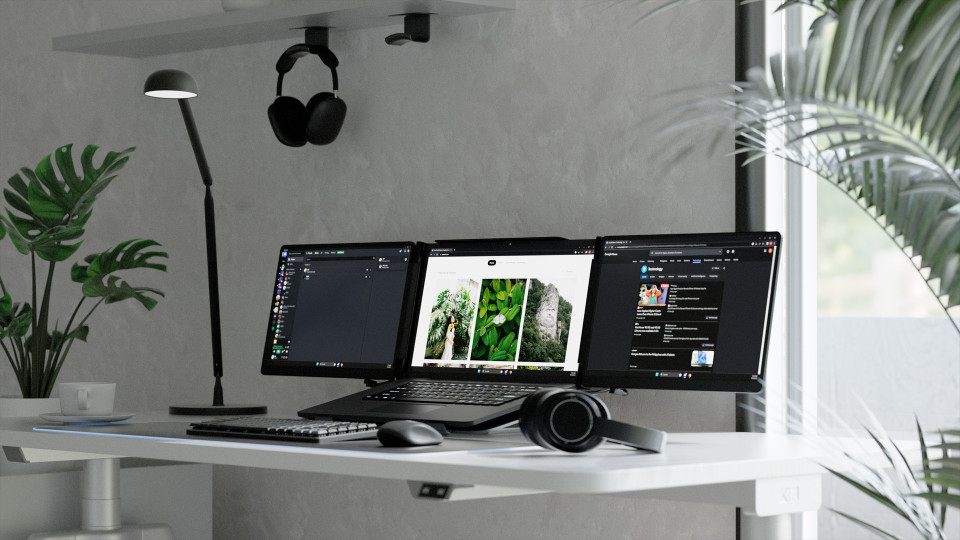
A single laptop screen forces you to choose: the document or the research, the video call or the notes. A tri-screen setup removes that choice. With the Monduo Pro Duo, two extra displays unfold from the back of your laptop, giving you three screens side by side wherever you work.
This guide covers what a tri-screen laptop setup is, who benefits most, how to arrange it ergonomically, and the mistakes that stop people getting the most from it.
What is a tri-screen laptop setup?
A tri-screen setup is your laptop's built-in display plus two additional screens, one on each side. Unlike a traditional triple-monitor desk with three separate monitors, stands and power cables, a portable tri-screen like the Monduo Pro Duo attaches to the laptop itself, so the whole workspace folds away and travels with you.
The Monduo Pro Duo comes in two sizes:
- Monduo 14 Inch Pro Duo: for 14" MacBook Pro (M1, M2, M3 Pro/Max and M4 or newer) and 14" to 15.6" PC laptops.
- Monduo 16 Inch Pro Duo: for 16" MacBook Pro and larger PC laptops.
Both use 2K screens with 500 nits of brightness, 100% DCI-P3 colour and a 144Hz refresh rate, and connect over USB-C/Thunderbolt or USB-C plus HDMI. Not sure what your laptop can drive? See how many portable monitors your laptop can support.
Why three screens beat one (or two)
The real cost of a single screen is switching: minimising one window to find another, losing your place, re-reading what you were doing. Three screens keep your primary task in the centre and your supporting information permanently in view on either side.
- Less tab-switching: reference material, communication and your main work stay visible at the same time.
- Better focus: each screen has one job, so your attention isn't constantly pulled back to window management.
- A balanced layout: with two side screens, your main screen stays centred in front of you, which a two-screen setup can't do.
- Portability: the same three-screen workspace at your desk, in a hotel or at a client's office.
Who benefits most from a tri-screen setup
- Developers: code in the centre, documentation on one side, terminal or test output on the other.
- Traders and analysts: live charts, news feeds and spreadsheets visible simultaneously.
- Remote professionals: a video call on one screen, CRM or project tools on another, email on the third.
- Designers and video editors: the editing canvas in the middle, references and asset libraries alongside. The colour-accurate panels help when matching work across screens.
- Students and researchers: lecture or source material, notes and the assignment open side by side.
How to set up your tri-screen workspace
- Check your ports. Confirm your laptop has two USB-C/Thunderbolt ports, or one USB-C and one HDMI, and use the included cables.
- Attach and angle the screens. Unfold the Pro Duo, mount it behind your laptop screen, and angle the side screens slightly inward so they wrap around your field of view.
- Install the Monduo app. On macOS or Windows, the Monduo app keeps brightness, resolution and display arrangement in sync with your laptop's own screen.
- Arrange your displays. In your system's display settings, match the on-screen arrangement to the physical layout so your cursor moves naturally between screens.
- Assign each screen a role. Decide what lives where (main work, reference, communication) and keep it consistent so it becomes muscle memory.
New to extra displays? Our complete guide to adding a second screen to your laptop walks through display settings step by step.
Ergonomics: set it up so you can work all day
- Raise the centre screen to eye level. A laptop stand puts the top of the main screen at or just below eye height, reducing neck strain.
- Keep a comfortable viewing distance. Roughly an arm's length from the centre screen; turn your head slightly for the side screens rather than leaning in.
- Angle the side screens toward you. This reduces glare and keeps text readable without twisting your posture.
- Use an external keyboard and mouse when the laptop is raised, so your wrists stay neutral.
- Light the room evenly and avoid a bright window directly behind the screens.
Tips to get more from three screens
- Save window layouts for repeat tasks (for example "writing", "calls" and "analysis") so you can restore them in seconds.
- Group related apps on the same screen instead of scattering them.
- Use portrait orientation on a side screen for long documents, code or chat feeds.
- Keep notifications on one side screen only, so the centre stays distraction-free.
- Manage cables neatly. A tidy setup is faster to pack away and set up again on the go.
Common tri-screen mistakes to avoid
- Sitting too close, which forces constant head-turning.
- Uneven or misaligned screens that make the cursor jump awkwardly between displays.
- Putting your main task on a side screen instead of the centre.
- Poor lighting that causes glare or eye fatigue.
- Ignoring display settings, so the on-screen arrangement doesn't match the physical one.
Is a tri-screen setup worth it?
If your work regularly involves more than one window, the answer is usually yes. The benefit isn't just more pixels: your information stays organised, visible and portable. For a closer look at the trade-offs, read is a triple monitor setup worth it, or see how the Pro Duo compares with the Mobile Pixels Trio and the Xebec Tri-Screen 3.
Ready to build yours? Explore the Monduo Pro Duo range. Every order includes free worldwide shipping and a 30-day trial.
Frequently asked questions
What is the Monduo Pro Duo?
The Monduo Pro Duo is a portable tri-screen accessory that adds two 2K displays to your laptop, one on each side, turning a single screen into a three-screen workspace you can fold away and carry.
Will the Pro Duo work with my laptop?
The 14" model fits 14" MacBook Pro (M1, M2, M3 Pro/Max and M4 or newer) and 14" to 15.6" PC laptops with dual USB-C/Thunderbolt, or USB-C plus HDMI. The 16" model is designed for 16" MacBook Pro and larger PC laptops. Check the product pages for full compatibility.
Is a tri-screen setup good for creative work?
Yes. Designers, photographers and video editors can keep the canvas in the centre with tools and references alongside, and the 100% DCI-P3 colour gamut helps keep colours consistent across screens.
Does a tri-screen setup help with ergonomics?
When arranged correctly, with the centre screen at eye level and the side screens angled inward, it reduces the head-turning and leaning that come from squeezing everything onto one small display.
What's the best way to organise three screens?
Give each screen a consistent role: main task in the centre, reference material on one side, communication or monitoring on the other. Then save those layouts for tasks you repeat.


